
WES & ECA in Canada: What Your Degree Is Worth in Points (and When You Don’t Need One)
IMMIGRATION
A lot of newcomers believe two things about their degree.
First, that listing it on an immigration profile is enough to earn points. Second, that once it’s “assessed,” they’re cleared to work in their field in Canada.
Neither is quite true. And mixing them up can cost you money, time, or both.
This guide untangles what an ECA actually is, how WES fits in, what it does for your score, and — the part most guides skip — when you might not need one at all.
ECA vs. WES: Are They the Same Thing?
This confused me for years, so let’s get it out of the way.
ECA stands for Educational Credential Assessment. It’s the type of report.
WES (World Education Services) is one of the organizations that issues that report.
Think of it like a medical check-up. “Check-up” is the service. The clinic you go to is a separate choice. When someone says “I did my WES,” they almost always mean “I got my ECA from WES.”
Here’s the catch. Organizations like WES also sell reports for other purposes, like university admission or job applications. As IRCC’s official ECA page points out, there are different types of ECAs, and you need one issued for immigration purposes. Pick the wrong product and you may end up paying twice.
Your Diploma vs. Your ECA: Two Different Jobs
“But I already submit my diploma and transcripts. Isn’t that proof?”
It is — just proof of something different.
| Diploma & transcripts | ECA report | |
|---|---|---|
| What it proves | You actually graduated | What your credential equals in Canada |
| Who issues it | Your school | An IRCC-designated organization |
| Earns Express Entry points? | Not on its own (for foreign education) | Yes |
So yes, you list your highest education in your profile. But for education completed outside Canada, Express Entry only gives you points for it when there’s a valid ECA behind it. You enter the ECA result and reference number right in your profile.
Education from a Canadian school is different. IRCC says you don’t need an assessment for a Canadian degree, diploma or certificate.
How Much Is an ECA Worth in Points?
This is where it gets real. Here’s what a few common results look like on the Comprehensive Ranking System (CRS), based on the points table on IRCC’s ECA page:
| ECA result (Canadian equivalent) | No spouse | With spouse |
|---|---|---|
| Two-year diploma | 98 | 91 |
| Bachelor’s (3+ years) | 120 | 112 |
| Two or more credentials (one 3+ years) | 128 | 119 |
| Master’s | 135 | 126 |
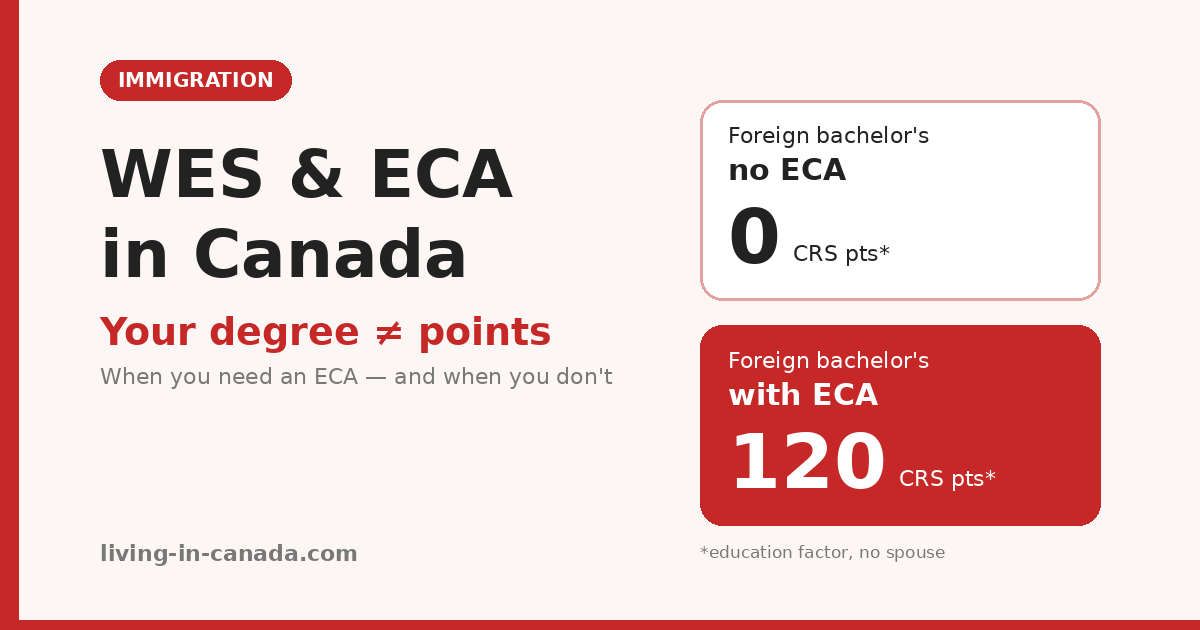
Now picture someone with a four-year bachelor’s from overseas and no ECA. On paper, they’re a university graduate. In the CRS education factor, they’re getting nothing for that degree. With an ECA, the same degree could add up to 120 points.
That gap is why so many people rush to get one. And sometimes that’s exactly right. But not always.
📌 You might also like:
Before You Pay: Do You Actually Need One?
About ten years ago, I was sitting in the pool with a four-year degree from back home. I’d decided to get it assessed — I was fairly sure it would be WES — because the extra points looked like my best shot.
I was just about to start the application when my invitation arrived.
My score had cleared the line without any education points from an assessment. For the pathway I was on, the ECA would only have added points, so I never needed it. I skipped it and kept the money. At the time, every dollar mattered — that saving was not small for us.
I’m not telling you to skip yours. I’m telling you to check first. Here’s how it breaks down:
| Your situation | Need an ECA? |
|---|---|
| Federal Skilled Worker, principal applicant, foreign education | Yes — it’s an eligibility requirement |
| Express Entry (e.g., CEC) and you want points for foreign education | Only if you want those points |
| Your highest education is Canadian | No |
| Your spouse has foreign education and is coming with you | Optional — it can add spouse points |
| Provincial program (e.g., BC PNP) | Check that program’s own guide |
If you’re not under FSW, try this: run your profile through the official CRS score tool twice — once with your foreign education counted, once without. Then compare both numbers with recent cut-offs. If the “without” score already competes, the ECA might be optional for you. If it doesn’t, the ECA may be the cheapest points you’ll ever buy.
Provincial programs have their own scoring systems. For B.C., the Skills Immigration Program Guide on WelcomeBC explains how education is scored and documented.
Which Organization Should You Use?
WES is the name everyone knows, but it’s not the only option. IRCC’s ECA page lists these designated organizations for most applicants:
- World Education Services (WES)
- International Credential Assessment Service of Canada (ICAS)
- Comparative Education Service (CES) – University of Toronto
- International Qualifications Assessment Service (IQAS)
- International Credential Evaluation Service (ICES) – BCIT
Some occupations must use a specific professional body instead. Doctors in certain occupations go through the Medical Council of Canada. Licensed pharmacists use the Pharmacy Examining Board of Canada. Licensed architects use the Canadian Architectural Certification Board.
IRCC notes that processing times and costs vary by organization. I’d compare a few based on how they want documents from your country — some require transcripts sent straight from your school, which can be the slowest part. Check the requirements for your country on each organization’s site.
The Mix-Up Nobody Warns You About: ECA Isn’t a Licence
This is the one I see trip people up after they arrive.
IRCC is clear that an ECA doesn’t guarantee a job in your field, and it doesn’t give you a licence to work in a regulated profession. If your job is regulated, you need to get licensed in the province where you’ll live.
| ECA | Professional recognition | |
|---|---|---|
| Purpose | Immigration points / eligibility | Permission to work in a regulated job |
| Who decides | Designated organization (WES, ICES, etc.) | Provincial regulator for that job |
| B.C. example | Bachelor’s = Canadian bachelor’s | ECE certificate from the ECE Registry |
Early childhood educators are a good example here in B.C. A WES report won’t make you an ECE. That certificate comes from the B.C. ECE Registry — and it’s the certificate that BC PNP’s childcare draws look at.
If you work in a regulated job, start with the federal foreign credential recognition page and then find your provincial regulator. Running both processes in parallel can save months.
Small Details That Cause Big Delays
Only assess what you need. In most cases, IRCC says you only need your highest level of education assessed. A master’s holder doesn’t need a separate report for the bachelor’s — unless you want points for two credentials, which needs one ECA for each.
Watch the five-year clock. Your ECA has to be less than five years old both when you complete your profile and when you submit your application. An expired one means a refused application.
Keep your originals. You enter the result in your profile, but you’ll upload copies if you’re invited to apply.
FAQ
My ECA is about to expire. Do I have to start over?
Not always. IRCC suggests contacting the organization that issued it — depending on the organization and report type, they may be able to re-issue it.
Can I use the WES report I got for a university application?
It has to be an ECA for immigration purposes. A different report type might be re-issued, but that depends on the organization, so ask them before you order a new one.
What if my ECA comes back lower than I expected?
To earn points, the report must show your credential equals a completed Canadian credential. If your post-secondary result doesn’t, IRCC notes you could get your high school credential assessed instead to earn points for secondary school.
Is WES better than the others?
For Express Entry, every designated organization’s ECA is accepted. The real differences are cost, timing, and document rules for your country.
Annie came to Canada with a degree from overseas and very little savings, and has now called Victoria, B.C. home for over ten years. She writes about the decisions she wishes someone had explained to her plainly — including which costs you can safely skip.
Still deciding whether points are your bottleneck? See how the cut-offs have been moving in my BC PNP draws 2026 breakdown, or start lining up paperwork with the PR document checklist.


One Comment