
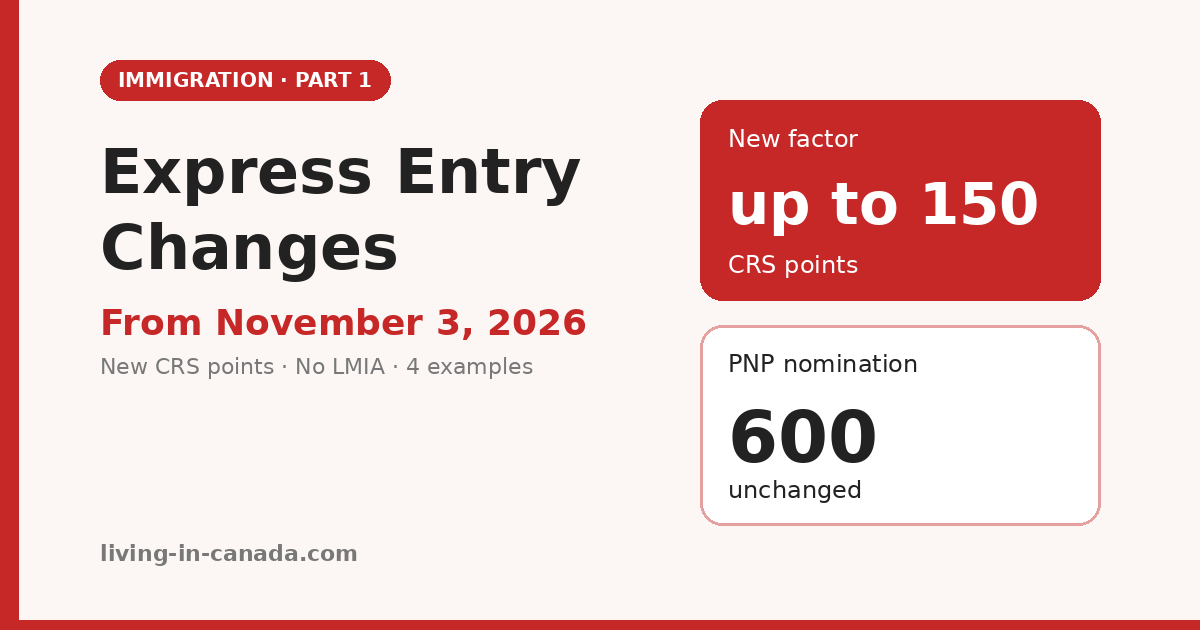
Express Entry Changes Nov 2026: New CRS Points Explained
IMMIGRATION · PART 1 OF 2
You’re sitting in the Express Entry pool. Or maybe you just got your BC PNP nomination and you’re waiting for the next draw.
Then you see the headline: “Express Entry is changing on November 3.”
Your first question is probably the right one: does this help me or hurt me?
The honest answer is that it depends on your job, your Canadian work history, and where you are in the process. So instead of just listing the new rules, I’ve worked through four example situations to show what actually changes for each.
What’s Changing on November 3, 2026
According to IRCC’s official changes page, three things shift at once.
1. A new “Labour Market Integration” factor (up to 150 points)
Your Canadian work experience points move into a new factor. Inside it, you get either your Canadian experience score or a job offer score — whichever is higher. Never both.
| Occupation level | Extra for 12+ months Canadian experience | Job offer points |
|---|---|---|
| At least 2× the average median wage | +70 | 100 |
| At least 1.5× | +40 | 70 |
| At least 1.3× | +20 | 50 |
| Not on the high-wage list | 0 | 0 |
The “extra” is added on top of the regular points for how long you’ve worked in Canada, which stay the same — 40 points for one year if you’re single, up to 80 for five years.
2. Job offers no longer need an LMIA
For Express Entry, a valid job offer doesn’t need a Labour Market Impact Assessment anymore — not for program eligibility, and not for points. Having one won’t earn extra points either. Instead, an officer checks whether the offer is genuine when you apply for PR.
3. A short pause in draws
IRCC will recalculate every profile in the pool, which it says could take up to two weeks. Invitation rounds pause during that time.
“High-Wage” Means Your Job Type, Not Your Paycheque
This trips up almost everyone.
IRCC looks at the median wage of everyone in Canada working in your NOC code. If that median is at least 1.3 times the national average median, the occupation is on the list. Your own salary doesn’t decide it.
So a well-paid worker in an occupation that isn’t listed gets nothing extra. Someone earning an ordinary salary in a listed occupation does.
There’s no single dollar threshold to memorize. Look up your NOC code on the list linked from IRCC’s changes page.
What Stays the Same
- Provincial nomination is still worth 600 points. The official changes page doesn’t touch it.
- Age, education, language and skills transferability are scored the same way.
- What counts as Canadian work experience hasn’t changed — it still has to be skilled (TEER 0–3) and authorized.
One caution: IRCC also published a broader consultation report on October 15 with other ideas, like merging programs. Those are proposals, not rules. Don’t plan around them until they’re officially announced.
📌 You might also like:
Four Examples: What Changes for Each Person?
These are made-up examples to illustrate the rules — not real people. All four are single (no spouse), and I’m only showing the work-experience/job-offer part of the score, because that’s the only part that changes.
Example 1 — Mina, on a working holiday
Mina came on a working holiday visa and has worked one full year as an early childhood educator in B.C. Her daycare offers her a permanent full-time role.
- Before Nov 3: 40 points (1 year of Canadian experience)
- After Nov 3: experience 40 + high-wage 0 = 40 · job offer 0 → 40 points
What it means: No change. Early childhood educators (NOC 42202) aren’t on the high-wage list, so neither her experience nor her offer earns extra. For Mina, a provincial route like the BC PNP childcare draws is still the more realistic path.
Example 2 — Daniel, on a PGWP
Daniel graduated in Canada and has worked two years as a software engineer (NOC 21231) on a post-graduation work permit. His employer also gave him a permanent offer.
- Before Nov 3: 53 points (2 years of Canadian experience)
- After Nov 3: experience 53 + high-wage 40 = 93 · job offer 70 → 93 points
What it means: +40. Software engineers sit in the 1.5× level. His job offer would only give 70, so the system uses the higher experience score. The offer doesn’t add on top.
Example 3 — Sofia, living overseas
Sofia has never worked in Canada. A Canadian company offers her a full-time software developer role (NOC 21232) after a series of remote interviews.
- Before Nov 3: 0 points (no Canadian experience; job offer points were removed in 2025)
- After Nov 3: experience 0 · job offer 70 → 70 points
What it means: +70 — the biggest jump of the four. But the offer is not a visa. Sofia still has to:
- qualify for a program on her own (likely the Federal Skilled Worker Program, which needs an ECA for foreign education)
- reach the draw cut-off with her total score
- show proof of funds — the exemption only applies if you’re already authorized to work in Canada and have a valid offer
She can’t work in Canada until her PR is approved — unless her employer separately supports a work permit.
Example 4 — Jun, a BC PNP nominee
Jun was nominated through the Express Entry BC option. His nomination is linked to his profile, and he’s waiting for an ITA from IRCC.
- Before and after: 600 nomination points stay
What it means: His ranking barely moves. The one real effect is timing — if the pause lands while he’s waiting, his ITA could come up to two weeks later than it otherwise would.
Here’s the same thing at a glance:
| Example | Before | After | Change |
|---|---|---|---|
| Mina — working holiday, ECE | 40 | 40 | 0 |
| Daniel — PGWP, software engineer | 53 | 93 | +40 |
| Sofia — overseas, job offer | 0 | 70 | +70 |
| Jun — BC PNP nominee | 600 (PNP) | 600 (PNP) | Timing only |
So Is This Better for Immigrants?
For some, clearly. For others, it’s quietly harder.
The winners are people in listed occupations with Canadian experience, like Daniel, and people with a qualifying offer, like Sofia. Employers can also make offers more easily now that LMIA costs and paperwork are out of the picture for Express Entry.
The quiet losers are people whose score stays flat while others rise. Express Entry is a ranking. If thousands of profiles gain 40 or 70 points, cut-offs in some draws could climb, and Mina’s unchanged 40 points may be worth less in practice. We’ll only know once draws restart.
PNP nominees like Jun are mostly unaffected.
If You’re a BC PNP Nominee: Which Stage Are You In?
| Your situation | Affected by the pause? |
|---|---|
| Nominated through Express Entry BC, waiting for an ITA | Yes — your ITA may be delayed |
| Already got your ITA and submitted your PR application | No — draws don’t affect processing |
| Nominated through the base (non-Express Entry) route | No — you don’t go through Express Entry draws |
One Odd Detail: The LMIA Box in Your Profile
IRCC says its online system won’t reflect the new rules right away. So if you have a job offer without an LMIA, the changes page tells you to answer “Yes” to the LMIA question and enter placeholder values (an LMIA number of 00000, plus set dates listed on that page).
It sounds wrong, but that’s the official instruction. Copy the values exactly from IRCC’s page rather than from a blog — including this one.
And if you want job offer points counted, IRCC asks candidates to update their profile before November 3.
FAQ
Can I get points for both my Canadian experience and my job offer?
No. You get whichever is higher. That’s why Daniel’s 70-point offer doesn’t add anything to his 93-point experience score.
Does my working holiday experience count?
It can, if the work was in a TEER 0–3 occupation and you worked the equivalent of at least one year full-time. Café or retail roles that fall under TEER 4 or 5 usually don’t count as skilled experience.
I earn a high salary. Why don’t I get the high-wage points?
Because the list is based on your occupation’s national median wage, not your personal pay. If your NOC code isn’t listed, your salary doesn’t change that.
Is the 600-point PNP bonus going away?
Not in the November 3 changes. Some proposals have discussed it in the past, but nothing official has changed. Keep an eye on IRCC announcements.
Annie has lived in Victoria, B.C. for over a decade and went through Canada’s PR process herself. Every time the rules shift, the first thing she does is ask, “Who does this actually affect?” — that’s the question this post tries to answer.
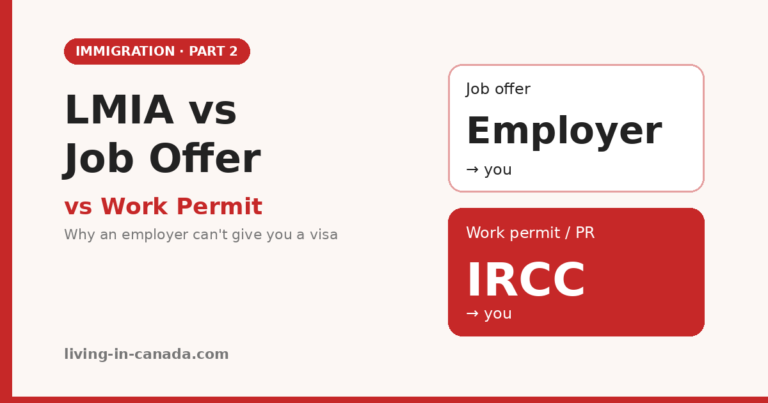
If you’re in the pool, the move this week is simple: look up your NOC code on IRCC’s list, and if you have a job offer, update your profile before November 3. Then read Part 2, where I untangle job offers, LMIAs, and work permits — because a job offer is not a visa.




One Comment