LMIA vs Job Offer vs Work Permit in Canada, Explained
IMMIGRATION · PART 2 OF 2
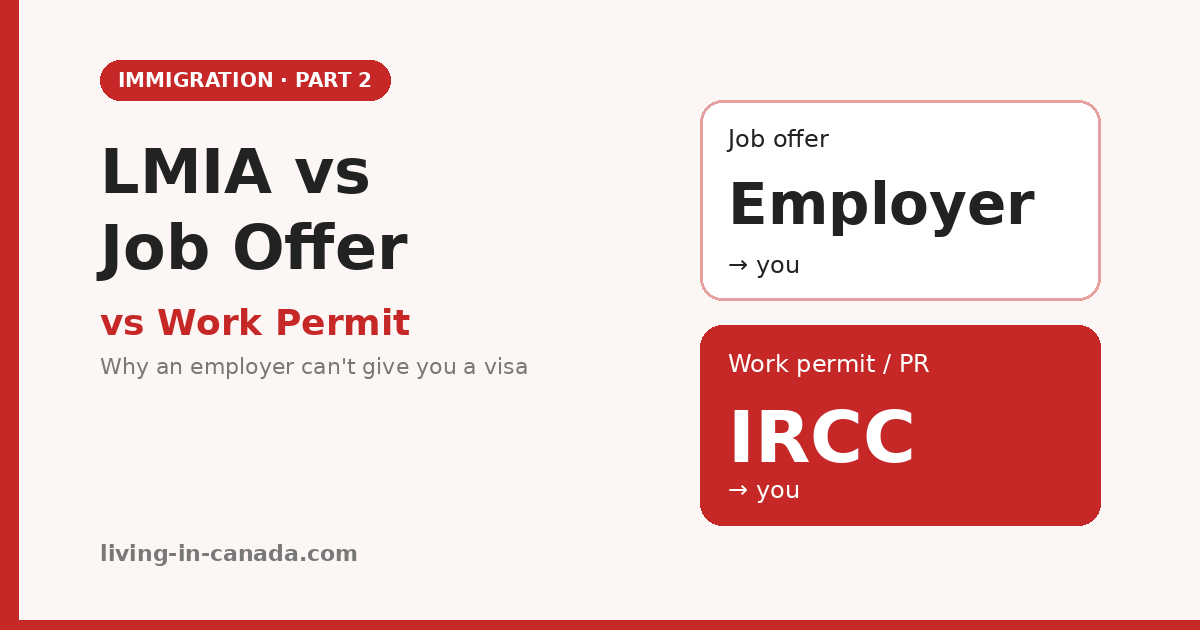
If you only read one thing here, make it this table. Four documents get mixed up constantly — and each one comes from a different place.
| Document | Who gives it | Given to | What it lets you do |
|---|---|---|---|
| Job offer | An employer | You | Nothing on its own — it’s a promise to hire |
| LMIA | The federal government (ESDC) | The employer | Lets the employer hire a foreign worker |
| Work permit | IRCC | You | Work in Canada, under its conditions |
| Permanent residence | IRCC | You | Live and work in Canada without a permit |
Notice what’s missing: no employer can issue you a visa. Only IRCC can. An employer can support your application — that’s it.
In Part 1, I walked through how Express Entry’s November 3, 2026 changes affect four example candidates. This part explains the documents behind those examples, so the new rules actually make sense.
A Job Offer Is a Promise, Not Permission
A job offer is the employer saying, “We’d like to hire you.” It lists the job, the pay, the hours.
That’s useful. It can earn Express Entry points and help you meet some program requirements. But it doesn’t give you the right to work here.
The reverse is also true. Having a work permit — even an open one, like a working holiday permit — isn’t the same as having a job offer. One is permission to work; the other is an employer’s commitment to you.
What makes a job offer “valid” for Express Entry
Based on IRCC’s job offer page, the offer generally has to be:
- In writing
- Full-time (at least 30 hours a week), paid and continuous
- For at least one year
- In a TEER 0, 1, 2 or 3 occupation
From November 3, 2026, IRCC’s changes page adds that the offer can be from a new or existing employer, for a new or existing position, and doesn’t need an LMIA. To earn points, though, it must also be in an occupation on the high-wage list.
LMIA: The Employer’s Permission Slip
A Labour Market Impact Assessment is something the employer applies for. It’s the government confirming that hiring a foreign worker for that job won’t hurt Canada’s labour market — usually because the employer couldn’t find a suitable Canadian.
It takes time, paperwork and fees, which is why many employers avoid it.
Here’s the part I most want people to understand:
Work Permit: Your Right to Work Now
A work permit is what lets you actually show up and do the job before you’re a permanent resident. Broadly, there are two kinds:
| Type | Who you can work for | Common examples |
|---|---|---|
| Open | Most employers | Working holiday, post-graduation work permit |
| Employer-specific | Only the employer named on it | Often LMIA-based |
Rules for each permit type differ by program and by country, so check the requirements for your country on IRCC’s site before you plan anything.
Putting It Together: Two Paths
These are the same made-up examples from Part 1, used only to show how the documents fit together.
Mina — already in Canada
Working holiday permit (open) → works a year in a skilled job → employer offers a permanent role → uses her Canadian experience for Express Entry or a provincial program.
Key point: Her permit lets her work now. The offer is a separate document — and her permit has an end date, so timing matters.
Sofia — still overseas
Job offer from a Canadian employer → qualifies for a federal program on her own → Express Entry profile with job offer points → ITA → PR application (officer checks the offer is genuine) → PR approved → then she can move and work.
Key point: Until her PR comes through, the offer doesn’t let her work in Canada. If the employer wants her sooner, they’d have to support a separate work permit — which is their choice, not an obligation.
How People Actually Get a Job Offer
From their current employer. This is by far the most common route. Someone on an open permit proves themselves at work, and the employer offers a permanent role.
Job searching inside Canada. The government’s Job Bank, LinkedIn and referrals all help. A Canadian-style résumé and local references matter more than most newcomers expect.
From overseas. It happens, but it’s harder. Employers rarely make permanent offers to people they haven’t worked with, especially without Canadian experience.
📌 You might also like:
Red Flags: When a “Job Offer” Is a Scam
Whenever rules change, scammers update their pitch. With LMIAs no longer needed for Express Entry offers, expect to see lines like “No LMIA needed now — pay us and your visa is guaranteed.”
Walk away if someone:
- Asks you to pay for a job offer. Real employers don’t sell jobs.
- Asks you to cover the employer’s LMIA costs. That’s the employer’s expense, not the worker’s.
- Promises a visa or PR. Only IRCC decides. No employer or agent can guarantee it.
- Offers a job you’d never actually do. IRCC officers now check whether offers are genuine, including whether you’re likely to take the job.
Using a fake or bought offer isn’t just a waste of money. It can count as misrepresentation, which can lead to a refusal and a ban from applying for several years.
FAQ
Does my employer give me a visa if they hire me?
No. Visas, work permits and PR are all issued by IRCC. An employer can support an application, for example by getting an LMIA, but the decision is always the government’s.
I’m on a working holiday. Do I need a job offer to apply for PR?
Not necessarily. Many people apply using their Canadian work experience alone. A job offer only adds Express Entry points if it’s in a high-wage occupation.
If I have a job offer, can I skip proof of funds?
Only if you’re also already authorized to work in Canada. Someone overseas with an offer, like Sofia, generally still has to show settlement funds for the Federal Skilled Worker Program.
Annie moved to Canada over ten years ago and now writes from Victoria, B.C. for people standing where she once stood — trying to make sense of forms, acronyms and advice that doesn’t always agree.
When I went through my own immigration, people around me used “LMIA” and “job offer” as if they meant the same thing. They don’t, and knowing the difference is what keeps you from paying for something that was never worth anything. If this cleared it up, Part 1 shows what the new rules mean in actual points.