
Canada Geese 101: What Newcomers Should Know Before Their First “Cobra Chicken” Encounter
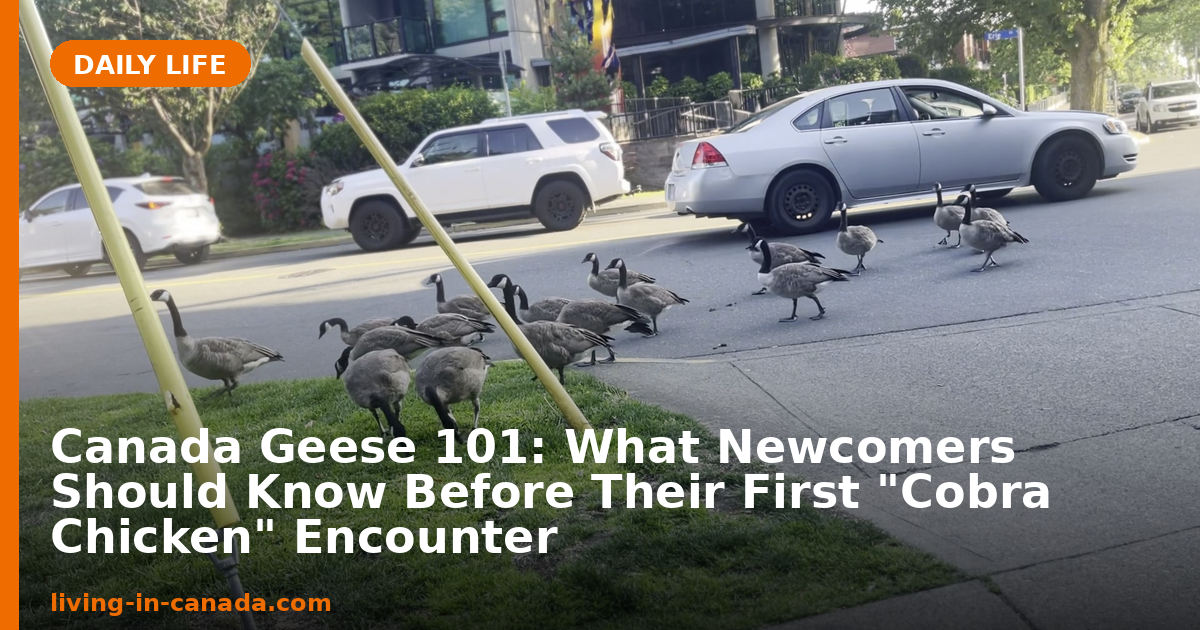
Last week I was walking through downtown and had to stop in the middle of the sidewalk. Not because of traffic — because of a small crowd of Canada geese calmly crossing the street like they owned it. Cars actually waited for them. Nobody honked. That’s just… normal here.
A few minutes later, I nearly stepped in something huge on the sidewalk and thought, “Who lets their dog leave a mess that big and just walks away?” I was genuinely annoyed for a second. Then I looked up and saw a goose standing three feet away, looking completely unbothered. That “dog mess” was goose poop. I had no idea they produced that much, that often.
That one walk sent me down a small rabbit hole. It turns out Canada geese are basically a national character here — beloved, mocked, and occasionally feared, all at once. If you’re new to Canada, here’s everything I wish someone had told me sooner.
The actual group of geese from my walk downtown, casually crossing the street while traffic waited.
Wait, Geese Just… Live in the City?
Yes. This surprised me more than almost anything else about daily life here. In a lot of countries, geese are something you see out in the countryside, not on your commute. But in Canadian cities, large populations of Canada geese have simply moved in — parks, retention ponds, office campuses, golf courses, even parking lots.
Many of these city geese are what wildlife biologists call “resident” populations. Unlike their cousins that fly thousands of kilometres between the Arctic and the southern U.S. every year, resident geese have decided city life is comfortable enough — mild winters, open lawns, no predators, and people who mostly leave them alone. So they just… stay.
Meet the “Cobra Chicken” — Canada’s Favorite Villain Bird
If you spend any time around Canadians, you’ll eventually hear someone call a goose a “cobra chicken.” It’s an affectionate insult, and once you understand where it comes from, it makes perfect sense.
When a goose feels threatened, it coils its long neck low to the ground, then suddenly rears up, spreads its wings, and hisses — exactly like a cobra about to strike. Add a loud honk and a full sprint in your direction, and you understand why people don’t take these birds lightly.
This isn’t just an online joke. A few years ago, staff at Canada’s Department of National Defence headquarters in Ottawa had to deal with an annual “goose invasion” during breeding season, with nests scattered across the parking lot and rooftops. According to a CBC report on the incident, a wildlife biologist explained that the geese become highly protective the moment they start laying eggs — which is exactly why the nickname stuck across the country.
So if a coworker warns you to avoid a certain courtyard in spring, believe them.
The Basics: Just How Big Are These Birds?
Once I actually looked into it, the poop mystery made a lot more sense. Canada geese are large birds, and they eat almost constantly.
| Trait | Detail |
| Length | About 75 cm to 1.1 m, depending on the subspecies |
| Weight | Roughly 3 kg to 8 kg — some “giant” Canada geese get close to 9 kg |
| Diet | Almost entirely grass, seeds, and leaves — which they eat in large amounts |
| Lifespan | Typically 10–20 years; the oldest known wild individual lived over 33 years |
| Flight speed | Up to about 65 km/h, with some flocks covering huge distances in a single day |
A bird that big, eating that much grass, all day, every day — the math on the sidewalk starts to make sense.
📌 You might also like:
When Do Canada Geese Get Aggressive? (Nesting Season Timeline)
This is the part every newcomer should actually bookmark. Geese aren’t aggressive year-round — it’s tied very closely to nesting season, which follows a fairly predictable pattern.
| Stage | Roughly When | What’s Happening |
| Pairing & scouting nests | Late February – March | Mated pairs (geese mate for life) pick a nesting spot, often close to water |
| Egg-laying | March – May | One egg roughly every day and a half; average clutch is 5 eggs |
| Incubation — peak aggression | ~28 days after the last egg | The gander guards the nest closely and will chase off anything that gets too close, including people |
| Hatching & molting | May – June | Goslings hatch and can walk/swim within a day; adults briefly lose flight feathers, making them extra protective since they can’t fly away from danger |
| Goslings fly | Late July – August | Once the young can fly, the aggressive behaviour drops off noticeably |
So in short: spring is goose-attack season. According to the Canadian Wildlife Federation’s Hinterland Who’s Who, geese rely on exactly this kind of aggressive posturing — hissing, wing-spreading, and bluff charges — as their main defence, since it’s often enough to scare predators away without an actual fight.